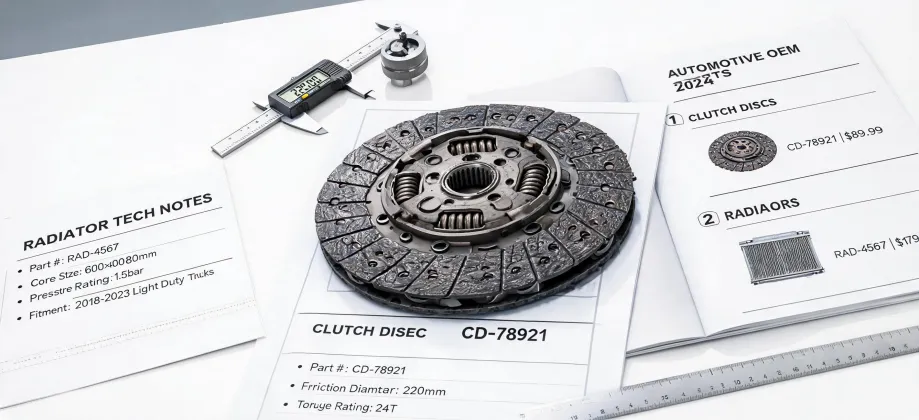
I coordinate rush parts orders for independent repair shops, which means I'm the person on the phone when a tech says, “Converter's bad. Get one here by Friday.” On a typical morning I move AISIN clutch discs and timing kits for scheduled jobs; converter calls are the ones that make me ask a second question.
“How long has the check engine light been on?”
If the answer is “a couple of days,” fine. If the answer is “well…” or “off and on since last fall,” then we're not ordering a converter. We're ordering the end of a story that started months earlier.
I've done this job for eight years — a few hundred rush orders, including a March 2024 call from a fleet shop that had 36 hours to pass an inspection or face a $12,000 penalty. That kind of deadline changes how you read small warnings. So here's what I tell people who look up signs the catalytic converter is bad.
The surface problem: what a failing converter feels like
The signs aren't subtle once they show up:
- A check engine light with P0420 or P0430 — “catalyst system efficiency below threshold” — often appears after a highway drive.
- A rotten-egg smell around a warm tailpipe.
- A hollow rattle under the car when you accelerate, which can mean the ceramic honeycomb inside has broken apart.
- Fuel economy drops by a noticeable amount, not just one or two mpg.
- The car runs fine around town but loses breath on the highway, especially uphill.
Any of these makes people search for a replacement converter. That's where the mistake starts. Those clues tell you the converter is failing; they don't tell you why.
The same psychology shows up with smaller things. A DS3 HID headlight bulb that's been turning pink for months still works — until it doesn't, right before a safety inspection. The bulb is a small part; the pattern is the same as a converter: the warning arrives long before the failure. If you ignore it, you pay for urgency later.
The deeper issue: converters don't die of old age
I'm not a catalyst chemist, so I can't walk you through washcoat formulations. What I can tell you after hundreds of orders is this: a catalytic converter rarely dies because it's old. It gets killed by the engine above it — usually by unburned fuel.
Here's the part people get backwards. A bad converter can make an engine run poorly once it's restricted, but thinking the misfire was caused by the converter is usually backwards. The misfire comes first. A worn plug, a dead coil, or a clogged injector sends raw fuel into the exhaust. The converter becomes an afterburner. The heat melts the ceramic inside, and now you have a plugged exhaust that causes even more driveability problems.
Under the EPA's general description (epa.gov), a catalytic converter uses platinum, palladium, and rhodium to cut carbon monoxide, hydrocarbons, and nitrogen oxides. That description matters because the converter is a chemical reactor. It only works when the mixture entering it is roughly correct. If the mixture is wrong day after day, the reactor fails.
The ECU backs this up. It doesn't call P0420 “converter broken.” It compares the upstream and downstream oxygen sensors; if the converter isn't storing oxygen like it should, efficiency looks low. That tells you what is failing, not why. The cause is usually one of these:
- Misfires dumping raw fuel in — by far the most common thing I see on high-mileage vehicles.
- Oil getting past worn valve seals or piston rings, coating the catalyst with ash.
- Coolant entering the exhaust from a head gasket issue, which contaminates the substrate quickly.
- A bad oxygen sensor or a long-term rich condition from a vacuum leak or fuel trim problem.
Notice what's missing from that list: “the converter got old.” It's a maintenance problem wearing a part problem's costume.
The same logic appears outside cars. Ask a commercial HVAC tech about a Honeywell RedLink wireless thermostat that “just stopped talking” to the heating system. Their first move is rarely ordering a new thermostat; they check the wireless link, the receiver, the power supply. The part that reports the failure is almost never the root cause.
What waiting actually costs
Let's talk money. Based on online parts quotes I pulled in January 2025, a direct-fit aftermarket converter for a mainstream pickup or SUV runs roughly $400 to $900, and an OE or dealer converter can land between $1,200 and $2,400 before labor. Add two to three hours of shop time, gaskets, and sometimes an oxygen sensor, and a converter repair is rarely a small bill. Prices shift; verify current quotes before you plan a repair.
Now add the cost of guessing. If the shop replaces the converter without finding the real cause, the new part starts dying the moment the car leaves. I've watched the same vehicle come back for a second converter within six months because nobody checked the misfire history. The second repair costs more than the first, and now the customer doesn't trust the shop.
Then there's the breakdown version of the same mistake. When the substrate collapses, it can block the exhaust so completely that the engine can't breathe, leaving you stranded on a trip — not at your own garage with tools and a parts counter nearby. Towing, a rental, missed work, and the rush order all stack on top of the part you were always going to need.
In March 2024, a shop called at 4:30 on a Thursday about a van that had failed a fleet inspection. Normal shipping would have taken five business days; the van had to pass in 36 hours or the operator faced a $12,000 penalty. The rush freight was $380 on top of the converter cost, and it was the easiest yes I heard all month. That's not paying for speed. That's buying certainty.
Fix the cause first, then the part
Before you order a converter, any competent shop should be able to answer three questions. First, are there stored misfire codes or high misfire counts? Second, what do the fuel trims and oxygen sensor readings look like on a live scan? Third, is the engine burning oil or coolant? If nobody can answer all three, you're gambling on a $1,000 part.
If the converter truly failed, get the right one — a direct-fit part for your exact vehicle, or the OE part if the budget allows. And if the diagnosis points to deferred maintenance, fix that too. On a high-mileage Toyota with the 4.7-liter V8, for example, a converter failure often happens around the age when timing service is due. If there's no proof the belt was done, put the AISIN timing belt kit for the Toyota 4.7 in the same repair plan; it's the type of part that quietly prevents a second breakdown. On a manual transmission car, a slipping clutch causes drivers to rev aggressively just to get moving, which pours hot, rich exhaust through the converter; here a fresh AISIN clutch disc and pressure plate belong in the conversation.
I'm not saying every converter replacement needs a timing belt, a clutch, and a full tune-up. I'm saying the converter sits downstream of everything else on the engine. It collects the consequences of other problems. Fix those, and the new converter has a fair chance. Ignore them, and you'll be ordering another one soon. When you do, you'll pay more for the rush than you would have paid for the diagnosis.
So what are the signs the catalytic converter is bad? The short list is the check engine light, the rotten-egg smell, the rattle, the fuel bill, and the highway struggle. The longer list includes everything else you've been putting off. A converter is a symptom with a platinum coating. The part that protects your wallet isn't the converter — it's the diagnosis you run before you buy one. And when the clock is running, pay for delivery certainty. The cheap “maybe” costs more than the guaranteed part, every time.