-
What This Comparison Is (and Isn't)
-
1. RAM AISIN Transmission Fluid vs. “It Meets the Spec”
-
2. AISIN AX15 Transmission: Remanufactured vs. “New” Surprise
-
3. Flywheel Slide: The 30-Second Check That Saves a Clutch Job
-
4. 350Z Intercooler: Universal Core vs. Specific Kit
-
5. Central AC Not Cooling But Fan Is Running: Symptom vs. Diagnosis
-
Where the Certainty Premium Pays for Itself
I'm a powertrain parts specialist who has handled OEM and aftermarket drivetrain orders for 12 years. I've personally made and documented 23 significant purchasing mistakes, totaling roughly $60,000 in wasted budget. Now I maintain our team's checklist so we don't repeat them. Some of those mistakes were simple spec check errors; others were deadline pressure. All of them came down to choosing hope over certainty. This article is the comparison I wish someone had shown me earlier: the “specified part” route vs. the “probably close enough” route.
What This Comparison Is (and Isn't)
I'm comparing two buying paths, not two brands. Path A is the OEM-specified or published-spec product. Path B is the cheaper, less-verified shortcut. I'll use five real cases to show where each path makes sense. The goal isn't to make every part OEM; it's to find where the “shortcut tax” appears. If you're under deadline pressure, one of these conclusions will be counterintuitive—it surprised me.
Not every decision needs a premium part. But every decision needs a defined reason to skip the spec.
1. RAM AISIN Transmission Fluid vs. “It Meets the Spec”
In September 2022, a fleet customer asked for RAM AISIN transmission fluid for a 2500 that was shifting harshly. We were out of the specified fluid, and the warehouse could deliver a “compatible” ATF by noon. I had about 3 hours to decide before the truck had to leave the shop. Normally I'd double-check the fluid cross-reference, but there was no time. I went with the compatible fluid based on the supplier's label.
The truck came back two days later with a transmission code. It didn't fail immediately. It failed after the customer left, which is the worst time. We flushed it and refilled with the correct AISIN fluid. I still kick myself for approving that compatible fluid. If I'd waited one day, the specified fluid would have been on the shelf. The mistake cost about $520 in labor plus the customer's downtime.
If I remember correctly, the issue wasn't viscosity on paper—it was the friction modifier package. I'm not a fluid chemist, so I can't speak to the exact additive differences. What I can tell you as a buyer is that swapping an unbranded “equivalent” after a warranty or calibration matters is a risk. Was the AISIN fluid more expensive? Yes. Was it more expensive than removing a valve body? No.
Decision: when the manufacturer names the fluid, use it. This is the dimension where “cheap” is rarely cheap.
2. AISIN AX15 Transmission: Remanufactured vs. “New” Surprise
The AISIN AX15 transmission has been out of production for years, so any replacement is a reman or a claim. We sourced the cheaper option in March 2019. The gearbox worked for a week and then got notchy on the 2-3 shift. When we pulled it, the synchro ring looked wrong. I should have asked for photos of the actual parts before ordering.
The replacement came with no build sheet, no synchro ring photos, no oil sample. The reman supplier sent a teardown report. That detail alone was worth the extra cost. We paid for a second unit plus an extra weekend of labor. The reman route cost 30% more upfront and saved a second install. (Should mention: the second shop was booked out two weeks, so the delay mattered more than the price difference.)
Decision: for discontinued transmissions, pay for the supplier who can show you the process, not just the part number. This is the counterintuitive one—the “new” product was not actually the better product.
3. Flywheel Slide: The 30-Second Check That Saves a Clutch Job
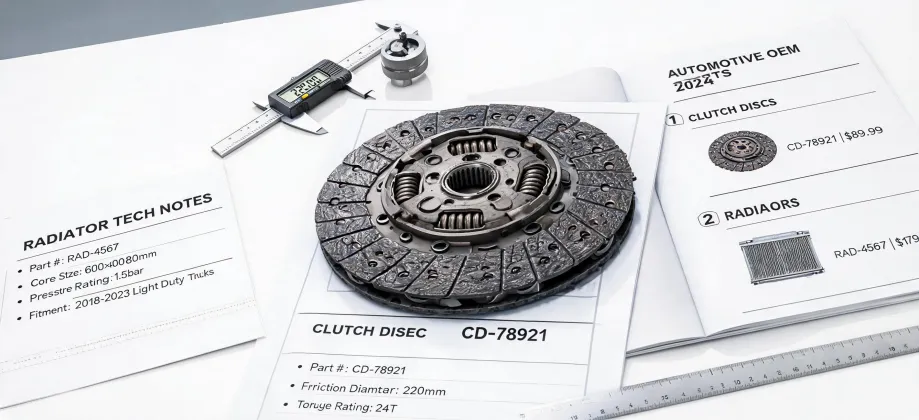
The phrase “flywheel slide” might not mean anything outside our shop. It's our checklist term for one test: after a flywheel is machined, it should slide onto the crankshaft pilot and locate on the dowel pins by hand. No tapping, no prying. If it doesn't slide, the register bore or mating surface is out of spec.
In 2021, a customer said “just bolt it on” to save time. We skipped the flywheel slide test. The flywheel was tight on one dowel, and the clutch disc didn't center properly. The result was a $1,400 redo and a missed delivery. In hindsight, I should have stopped the job and measured the bore. But with the boss standing there saying “it's fine,” I let the timeline push me. We now record the fit on every flywheel job. It's one line on the checklist, but it catches the kind of tolerance issue that shows up 5,000 miles later.
Decision: on clutch and flywheel jobs, the 30-second flywheel slide check is a certainty tool. It doesn't make the job more expensive; it makes the job done once.
4. 350Z Intercooler: Universal Core vs. Specific Kit
I'm not a turbo-system engineer, so I don't trust myself to guess core sizing for a 350Z build. In my first year (2017), we ordered a universal intercooler because the 350Z intercooler kit was $380 more. The core was actually too wide; our fabricator had to cut the front bumper support. That modification took three days and cost $600 in labor. The “cheaper” core turned out to be the expensive one.
Had the delivery date been fixed, the delay would have been worse. The universal core can work for a custom build. But “universal” means you're paying for fabrication time in addition to the part. The right intercooler isn't just about core size. Inlet and outlet angles, end tank shape, and mount locations matter. A universal core can be adapted; a specific kit is already engineered. For a street 350Z, the vehicle-specific kit usually gets you to the end faster.
Decision: if your deadline matters, choose the package engineered for that chassis. If you're building something intentionally custom, the universal core is not a mistake—just budget the extra time.
5. Central AC Not Cooling But Fan Is Running: Symptom vs. Diagnosis
Our office facilities manager described a central AC not cooling but fan is running. The fan is the symptom that tricks everyone. In 2024, I made the same mistake on a shop A/C unit: I approved a refrigerant top-off because the compressor line “felt” cold. The top-off did nothing. The real issue was a bad contactor. Had we checked the compressor amperage and pressure first, the repair would have been $85 and 40 minutes, not $240 and a lost afternoon.
A moving fan creates the illusion of action. If the compressor isn't cycling, the system is just moving air that isn't cold. That's hard to accept when the part appears to be working. I'm not an HVAC technician, so I can't speak to every refrigerant rule or diagnostic procedure. But as a buyer, I learned that the fan running is not the same as the system working. This is the same logic as a transmission: fluid moving doesn't mean pressure is right.
Decision: when a system fails with an obvious symptom but the obvious subsystem is still running, resist the shortcut. Run the test that measures output, not motion.
Where the Certainty Premium Pays for Itself
I used to think paying extra for certainty was a luxury. After the mistakes above, I see it as a hedge. In March 2024, we paid $400 extra for expedited production on a batch of AISIN-related parts. The alternative was missing a $15,000 customer commitment. That $400 bought a schedule we could rely on. The way I see it, uncertainty has a price; sometimes it's just not on the invoice.
Not every part needs the premium route. Our checklist now asks two questions before any non-spec order: What is the failure cost if this part is wrong? When is the deadline? If either answer is “high” or “firm,” the premium route becomes the low-risk route. That's not overbuying; that's risk management. And it's the main thing I want the next person to learn without paying the tuition I did.